Agentic AI is no longer a recommendation engine sitting beside the procurement team. It monitors suppliers, screens risk, drafts tenders, and in the most advanced deployments initiates sourcing steps on its own. As that shift accelerates, one decision is proving more consequential than most executives assumed: whether the agent is built and owned inside the organisation, co-developed with a partner, or bought as a service. Sourcing is usually framed as a cost and speed question. The evidence suggests it is really a question about capability and control.
Across the organisations studied, three sourcing settings stand apart. In-house developers develop and run the agent themselves. Hybrid organisations co-develop it with an external partner, keeping shared ownership of the capability. Outsourced organisations receive a finished agent operated by a vendor. These are not just procurement choices for a piece of software. They shape how far the technology travels inside the business.
Maturity and deployment follow ownership
The clearest pattern is that organisations that developed agentic AI in-house are further along. They report the highest maturity, run more pilots, and move more of them into production. On average, these organisations have 3.1 agentic use cases running in production, against 2.4 for those who pursued a hybrid sourcing setting and 1.7 for those who completely outsourced. The gap widens with deployment intensity, a measure that rewards both breadth and depth of live use. In-house settings lead, hybrid settings sit close behind on breadth but are thinner in production, and completely outsourced settings trail on both.
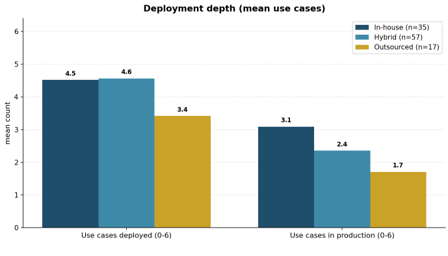
Deployment depth by sourcing setting (mean count of use cases, 0–6).
Part of this reflects time. Organisations that chose to build in-house have generally been at it longer, and tenure buys deployment experience. But the direction is consistent: the more an organisation owns the agent, the more of it ends up doing real work.
Internal capability is where the settings truly diverge
If deployment is a gradient, capability is a cliff. Forty-six percent of the organisations that pursued in-house development describe their internal agentic AI capability as fully sufficient. Among those that followed a hybrid approach, that figure collapses to 7 percent, and among those who completely outsourced to 6 percent. At the other end of the scale, those who completely outsourced are the most likely to report major capability gaps that limit progress.

Internal capability self-sufficiency by sourcing setting (% of group).
This is the structural consequence of the sourcing choice. Developing in-house forces an organisation to accumulate proprietary understanding of why the agent behaves as it does, how its data are prepared, and where its judgement must be constrained. Co-developing and outsourcing build proficiency with a partner or vendor instead. That proficiency is genuine, but it is more transferable and less owned, and it leaves a larger share of organisations dependent on outside help for routine operation.
Ownership buys the confidence to let go
Capability translates directly into how much freedom organisations grant the agent. Organisations that developed in-house reported the highest percentage of autonomous agents: 37 percent operate fully autonomous agents, compared with 16 percent for a hybrid setting and 18 percent for a completely outsourced approach. Also, those who outsourced were the most likely to keep the agent in an assistive, recommendation-only role. Trusting an agent to act without a human in the loop appears to depend on understanding it well enough to predict it, and that understanding is built, not bought.

Agent autonomy level by sourcing setting (% of group).
Yet the value realised looks remarkably similar
Here the story seems to turn. On the results businesses actually see today, the three settings converge. The overall performance rating sits at 3.4 for in-house, 3.2 for hybrid, and 3.1 for outsourced on a five-point scale. Internal and external value realised differ by only a few tenths of a point. Cycle-time reductions and freed capacity are close across all three. In-house settings edge ahead on cost savings and stakeholder satisfaction, but the margins are small. What looks like parity, though, is a snapshot of where agents do bounded work today — not a verdict on where each setting can take them tomorrow.
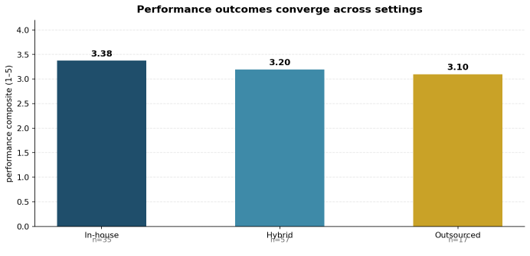
Performance composite by sourcing setting (mean, 1–5).
The lesson is not that building in-house is wasted effort. It is that the value an organisation extracts from agentic AI today is shaped more by execution, data quality, and use-case fit than by the sourcing route. A capable outsourced deployment and a capable in-house deployment tend to land in a similar place on results. Perceived barriers tell the same balanced story: organisations pursuing a hybrid approach feel governance and legal friction a little more acutely, while technical and financial concerns are spread evenly.
So sourcing does not buy performance. It buys capability, autonomy, and ownership. For organisations that treat agentic AI as a temporary efficiency tool, outsourced or hybrid provision delivers comparable results at lower internal cost. For those that intend agentic AI to become a proprietary capability that compounds as agents take on more consequential decisions, the in-house route is where that capability is actually being built. The performance numbers are similar now. The capability gap is not, and it is the capability gap that will decide who can ask more of their agents next.
Four questions for managers weighing the sourcing decision
- Decide what you are optimising for. If the goal is a quick, reliable efficiency gain on standard use cases, hybrid or outsourced provision reaches comparable outcomes at lower internal cost. If the goal is a durable capability that compounds, weight the decision toward building.
- Do not confuse similar results today with equal readiness tomorrow. Outcomes converge now because most agents still handle bounded tasks. As autonomy rises, only organisations that understand their agents deeply will be able to extend that autonomy safely. Judge the sourcing choice against where you want the agent to be in three years, not where it is today.
- Treat outsourcing as a starting point, not an end state. Organisations that fully outsourced trail on capability, autonomy, and deployment depth. If you begin there for speed, define from the outset what a transition to greater internal ownership looks like, so dependency does not become permanent by default.
- Invest in the capability, not just the tool. The sharpest divide is internal self-sufficiency. Whichever route you choose, budget deliberately for the data preparation, governance skills, and internal expertise that let your team understand and steer the agent, because that is what separates the settings, and it is what performance will eventually rest on.
| About this research
The findings draw on a survey of procurement and supply-chain organisations deploying agentic AI. For this analysis the sample is grouped by how each organisation sources its agentic capability: in-house (fully developed and operated internally, 35 organisations), hybrid (co-developed with an external partner, 57 organisations), and outsourced (provided and operated by an external vendor, 17 organisations). The patterns should be read as indicative directions rather than confirmed effects, and the deployment differences partly reflect that in-house programmes have been running longer. |
About the author team:
Ilan Oshri is Director of CODE (Centre for Digital Enterprise) at the University of Auckland and a leading scholar on digital strategy and outsourcing. His research examines how organizations govern and capture value from digital and AI-enabled transformation.
Heiner Himmelreich is a Partner and Director at Boston Consulting Group, where he leads work on Technology and Digital Advantage. His focus spans digital transformation and the strategic application of emerging technologies across industries.
Paolo Scala is a Senior Consultant at BCG PLATINION, BCG’s tech build and design unit, based in Milan. He specializes in technology-driven transformation and the operationalization of advanced AI in complex enterprise environments.
Annas Ziadani is a Director at BCG Platinion, BCG’s tech build and design unit, based in Brussels. A member of BCG’s global expert network for tech sourcing and procurement, he focuses on large-scale transformations driven by cost optimization, technology sourcing, and AI-enabled operating models.